
Ultrafast chemistry: An optimized tool for the job
How the chemRIXS instrument team got an upgraded spectrometer with a boost in capability from LCLS-II.
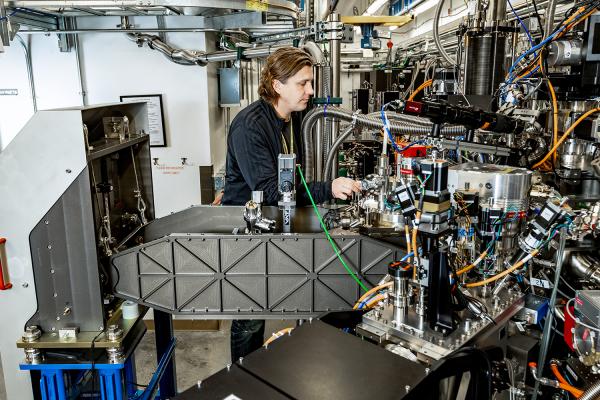
An array of recently upgraded instruments at SLAC’s LCLS facility has equipped researchers with a new X-ray laser toolkit. We had a look behind the scenes to see how one of these instruments came together. Supported by Basic Energy Sciences through LCLS operations funding to enhance LCLS experimental capabilities, chemRIXS Instrument Lead Kristjan Kunnus and his team procured a new spectrometer – one of four redesigned instruments to serve users. Now, the optimized tool is enabling researchers to study ultrafast chemical processes like never before.
Using X-rays from the linear accelerator (linac) and a technique called resonant inelastic X-ray scattering (RIXS), the Spherical Varied Line-Space (SVLS) spectrometer measures the properties of light emitted from energized electrons deep within a sample. This capability is enhanced by an optimized spectrometer design, improving the detection efficiency of light as it’s dispersed into its constituent wavelengths by a process called grating. “The spectrometer’s state-of-the-art grating, detector technologies and compact design contribute to this efficiency,” said Kristjan.
How it used to be
The chemRIXS instrument always had a spectrometer, which it inherited from the Soft X-ray (SXR) endstation. But like the SXR endstation at LCLS-I, it was not designed for the highly sensitive RIXS spectroscopy of sample solutions with low concentrations.
“The old spectrometer benefitted a variety of user experiments at chemRIXS,” said Thomas Wolf, chemical sciences department head at LCLS. But with LCLS-II moving toward generating one million X-ray pulses per second for the LCLS-II High Energy upgrade, Kristjan anticipated that a more advanced spectrometer with a higher degree of sensitivity would be needed.
New design and engineering
Kristjan put together a team to work out the optical design and custom SVLS grating of the spectrometer. With support from Georgi Dakovski, former chemRIXS instrument lead, and Joe Dvorak from Brookhaven National Laboratory, the team got to work. They leveraged their collaboration with Brookhaven, where Joe had contributed to the design of the spectrometer at qRIXS, to work out an optical design that maximized throughput and factored in grating manufacturing technologies.
For the engineering design, Hengzi Wang at LCLS led a team that included Jean-Pierre Torras, Rick Bonnell and Divya Kameswaran to work out the mechanical and controls design for the spectrometer. Working with an external vendor, the team facilitated the manufacturing of all the spectrometer’s mechanical systems.
Installation and readiness during Run 24
Several people were crucial to the successful installation and deployment of the spectrometer in the Near Experimental Hall, where the chemRIXS hutch is located. They included area managers K Ninh and Raybel Almeida, who accommodated the installation during Run 24, and Kuktae Kim who led the software development for the spectrometer’s novel detector.
chemRIXS Instrument LeadThanks to the amazing joint effort of all these teams, the chemRIXS team was able to follow this great work to successfully commission the spectrometer.
In May, the spectrometer was transferred from commissioning to operations where all four user experiments of Run 24 have already benefitted from its upgraded capabilities. “The instrument works exceedingly well and has been deployed to great success,” said Thomas.
Optimized for LCLS-II
One of the enhancements of the LCLS-II beam is the ability to generate X-ray pulses that are slightly less intense but more frequent. “That means the photons are distributed much more evenly,” said Thomas. When those photons reach a sample at chemRIXS, they interact with it, generating X-ray photons in the sample with a wavelength that differs from the incoming photons. The resulting emitted X-ray spectra contain real-time information about where and how the sample makes or breaks chemical bonds.
To see what happens on the incredibly small scales where these bonds are made and broken, the LCLS-II beam's intensity, or flux, can be ramped up to much higher levels than before. “We need roughly 300 times more flux, which is now what we get from LCLS-II,” said Thomas.
When that light is measured with the SVLS spectrometer, Thomas said the difference is staggering. “We can now detect photons with a factor of 40 in sensitivity.” That’s very good news. It means that samples can be 40 times less concentrated than before, including those not easily synthesized. That capability will enable experiments that rely on smaller quantities of photons, unlocking completely new areas of photochemistry and biology.


